Two Extraordinary Villas on the French Riviera: Villa Ephrussi de Rothschild & Villa Kérylos
There are plenty of beautiful villas on the French Riviera.Then there are the ones that make you stop and think: how on earth did someone imagine this?Two of the most remarkable are found on the peninsula of Saint-Jean-Cap-Ferrat, between Nice and Monaco: the Villa Ephrussi de Rothschild and Villa Kérylos.They stand only a short distance from one another, yet they could hardly be more different.One is an extravagant Belle Époque residence surrounded by spectacular gardens, created by the fabulously wealthy Baroness Béatrice de Rothschild.The other is a remarkable early-20th-century interpretation of an ancient Greek villa, created by the archaeologist and Hellenist Théodore Reinach.Together, they make one of the most fascinating cultural day trips on the Côte d'Azur.And if you are staying at Gaia's Villas in Théoule-sur-Mer, they are well worth adding to your Riviera itinerary.
Villa Ephrussi de Rothschild: A Belle Époque Dream Above the Mediterranean
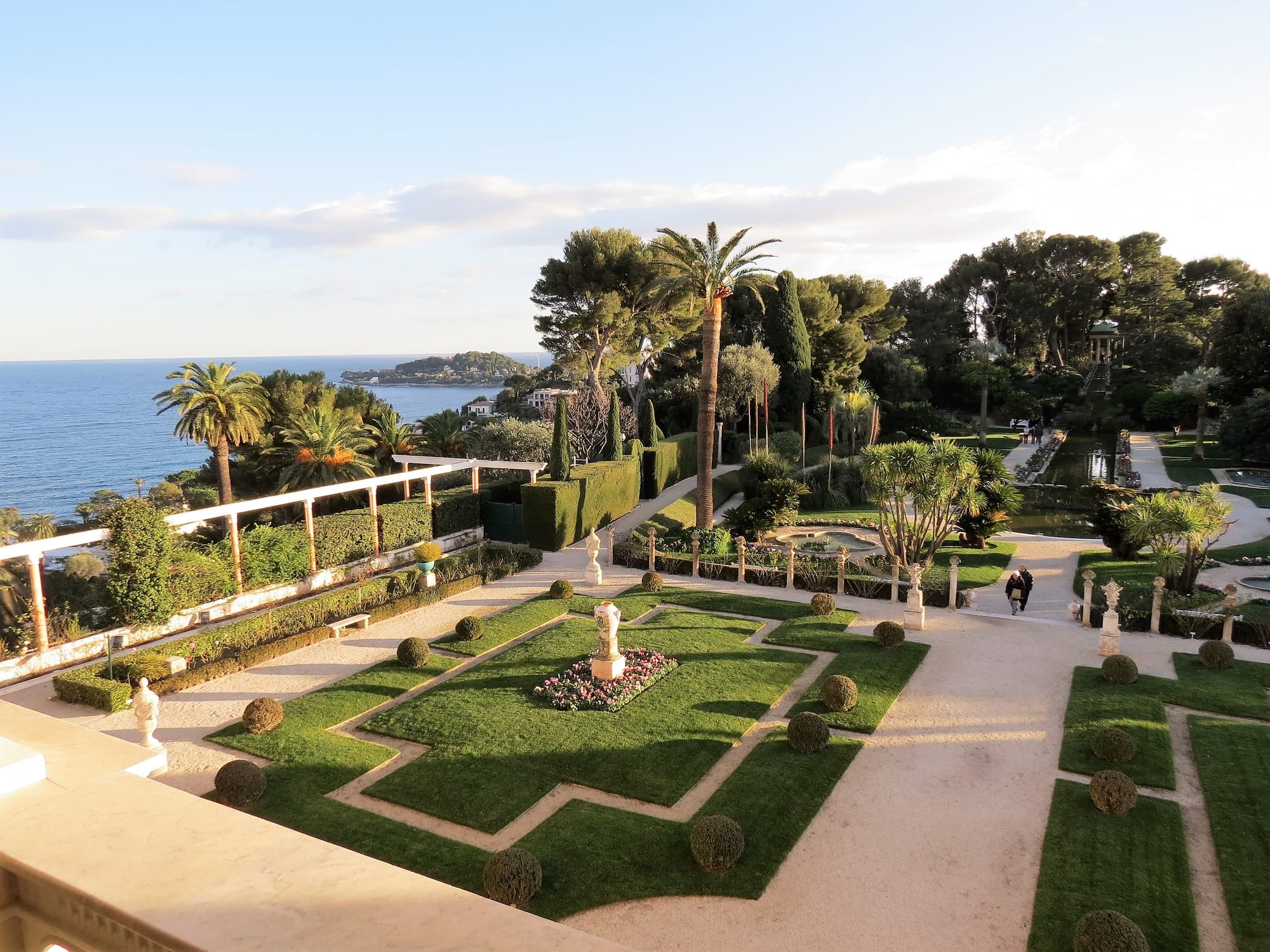
Perched on the narrow Saint-Jean-Cap-Ferrat peninsula, the Villa Ephrussi de Rothschild is one of those places that feels almost too extravagant to be real.The villa was created by Béatrice de Rothschild, a member of the wealthy Rothschild banking family, in the early 20th century.Béatrice had an extraordinary passion for art, architecture, gardens and beautiful objects.And rather than choosing just one style, she essentially decided to have several.The result is a magnificent pink-and-white villa surrounded by an equally extraordinary collection of gardens.From the outside, the setting alone is spectacular.The villa sits between the Mediterranean and the gardens, with views stretching across the water towards the surrounding coastline.Inside, the rooms are filled with period furniture, paintings, porcelain, tapestries and decorative objects.But it is the gardens that make the experience particularly memorable.
Nine gardens, one villa
The gardens are divided into different themes, including French, Spanish, Florentine, Japanese and exotic gardens.The famous French garden is arranged around a large reflecting pool, with fountains and musical water displays creating one of the villa's most recognisable views.It is wonderfully theatrical.And then, just a few steps away, the atmosphere changes completely.You move from formal French geometry to a Japanese garden, then to a more Mediterranean landscape, then to another style entirely.It is almost as if the owner collected gardens in the same way that she collected art.
The Villa That Changes Character as You Walk Through It
One of the pleasures of visiting Villa Ephrussi is that there isn't really one single view or one single style.The house itself is elegant and intimate compared with some of the enormous palaces of the Riviera, but the decoration is rich and detailed.Look closely and you'll find furniture, paintings, porcelain and objects collected from different periods and places.It is very much a reflection of Béatrice herself.And there is something wonderfully Riviera about the whole thing.It is elegant without being minimalist, extravagant without pretending otherwise.The villa was designed to be enjoyed.And you can feel that.
Villa Kérylos: A Journey to Ancient Greece
Just a short distance away, the atmosphere changes completely.If Villa Ephrussi is Belle Époque glamour, Villa Kérylos is something much more unusual.It is not an ancient Greek villa.It is a modern interpretation of one.Built at the beginning of the 20th century for Théodore Reinach, a French scholar, archaeologist and politician fascinated by ancient Greece, Villa Kérylos was designed as a recreation of an ancient Greek aristocratic residence.Reinach worked with architect Emmanuel Pontremoli to create a house inspired particularly by Greek architecture and the ancient villas of the Aegean world.The result is extraordinary.Rather than simply copying an archaeological site, the architects reimagined what an ancient Greek house might have been like if it had been built with early-20th-century craftsmanship and technology.The effect is almost theatrical — but in a very different way from Villa Ephrussi.
Inside Villa Kérylos
The villa is organised around a central courtyard, as a traditional Greek house might have been.The rooms are decorated with mosaics, frescoes, carved wood, marble and furniture inspired by ancient Greek designs.There are columns everywhere, but the house never feels like a museum filled with isolated objects.It feels like a home.That is what makes Villa Kérylos so interesting.You can imagine people actually living there: dining, reading, bathing, talking and looking out towards the Mediterranean.The designers paid extraordinary attention to detail.Even the furniture was specially created to evoke ancient Greek forms.There are beds, tables, chairs, lamps, storage chests and other pieces designed specifically for the villa.And yet this is not simply an exercise in historical imitation.Modern comforts were incorporated discreetly into the design, creating a fascinating mixture of ancient inspiration and early-20th-century innovation.
Two Villas, Two Very Different Visions of Luxury
Visiting the two villas together is fascinating precisely because they represent completely different ideas of beauty.Villa Ephrussi de Rothschild is about abundance.Gardens, fountains, art, colour, decoration and the sheer pleasure of surrounding yourself with beautiful things.Villa Kérylos is about harmony.Architecture, proportion, materials, light and the relationship between the house and the sea.One looks towards the glamour of the Belle Époque.The other looks backwards to ancient Greece.And both were created by people who had the means — and the imagination — to build something entirely personal.Perhaps that is what makes them so compelling.They aren't simply beautiful houses.They are portraits of the people who created them.
Saint-Jean-Cap-Ferrat: One of the Riviera's Most Beautiful Corners
The villas are located on and around the magnificent Saint-Jean-Cap-Ferrat peninsula, an area known for its beautiful coastline, elegant villas, pine trees and exceptionally clear Mediterranean water.The peninsula has long been associated with wealth and privacy, but it is also a wonderful place simply to spend a day.After visiting the villas, you can walk along the coast, stop for lunch, swim in the Mediterranean or simply enjoy the views.The contrast with the busier parts of the French Riviera is noticeable.There is a slower rhythm here.And the landscape is spectacular.The road winds around the peninsula between pine-covered hills and the sea, with beautiful views towards Beaulieu-sur-Mer, Villefranche-sur-Mer and the surrounding coastline.
Can You Visit Both Villas in One Day?
Yes — and we would recommend doing exactly that.The two villas are close enough to combine into one outing, making them a particularly good choice for a day when you want something different from beaches, shopping and restaurants.Start with Villa Ephrussi de Rothschild, allowing enough time to explore the house and gardens without rushing.Then continue to Villa Kérylos and explore the rooms, courtyard and extraordinary details of the Greek-inspired architecture.Afterwards, take your time around Beaulieu-sur-Mer or Saint-Jean-Cap-Ferrat.Have lunch.Go for a walk.Perhaps have a swim.The Riviera is not somewhere to be experienced entirely according to a timetable.Leave some space in your day for discovering something you didn't plan.
A Wonderful Day Trip from Théoule-sur-Mer
From Gaia's Villas in Théoule-sur-Mer, Saint-Jean-Cap-Ferrat is towards the eastern end of the Riviera, beyond Cannes and Nice.It is a longer day out than visiting Cannes or the Esterel, but it is a beautiful way to discover a completely different side of the Côte d'Azur.And the journey itself takes you through some of the Riviera's most famous landscapes.You can combine the villas with a stop in Villefranche-sur-Mer, one of the most beautiful villages on the coast, or continue towards Monaco if you want to make a full day of it.Alternatively, keep the day simple.Visit the two villas, have lunch by the sea, take a walk and come home to Théoule before dinner.Sometimes that is more than enough.
A Little Riviera History, a Lot of Beauty
The Côte d'Azur is often associated with beaches, yachts, glamorous hotels and summer nightlife.But places like Villa Ephrussi de Rothschild and Villa Kérylos reveal another side of the Riviera.They tell the story of people who came here not simply to holiday, but to create extraordinary homes inspired by their passions.One imagined a world of Belle Époque elegance and magnificent gardens.The other brought ancient Greece back to life beside the Mediterranean.Both are completely unique.And that is perhaps the best reason to visit.You won't simply be ticking another attraction off your list.You'll be stepping into two very different dreams of what life beside the Mediterranean could be.And then, at the end of the day, you can return to Théoule, swim in your pool, open a bottle of wine and enjoy your own much simpler version of Riviera living.Which, after all, is also rather lovely.
