Cap Dramont & Île d’Or: Red Rocks, Coastal Walks and a Little Mediterranean Kingdom
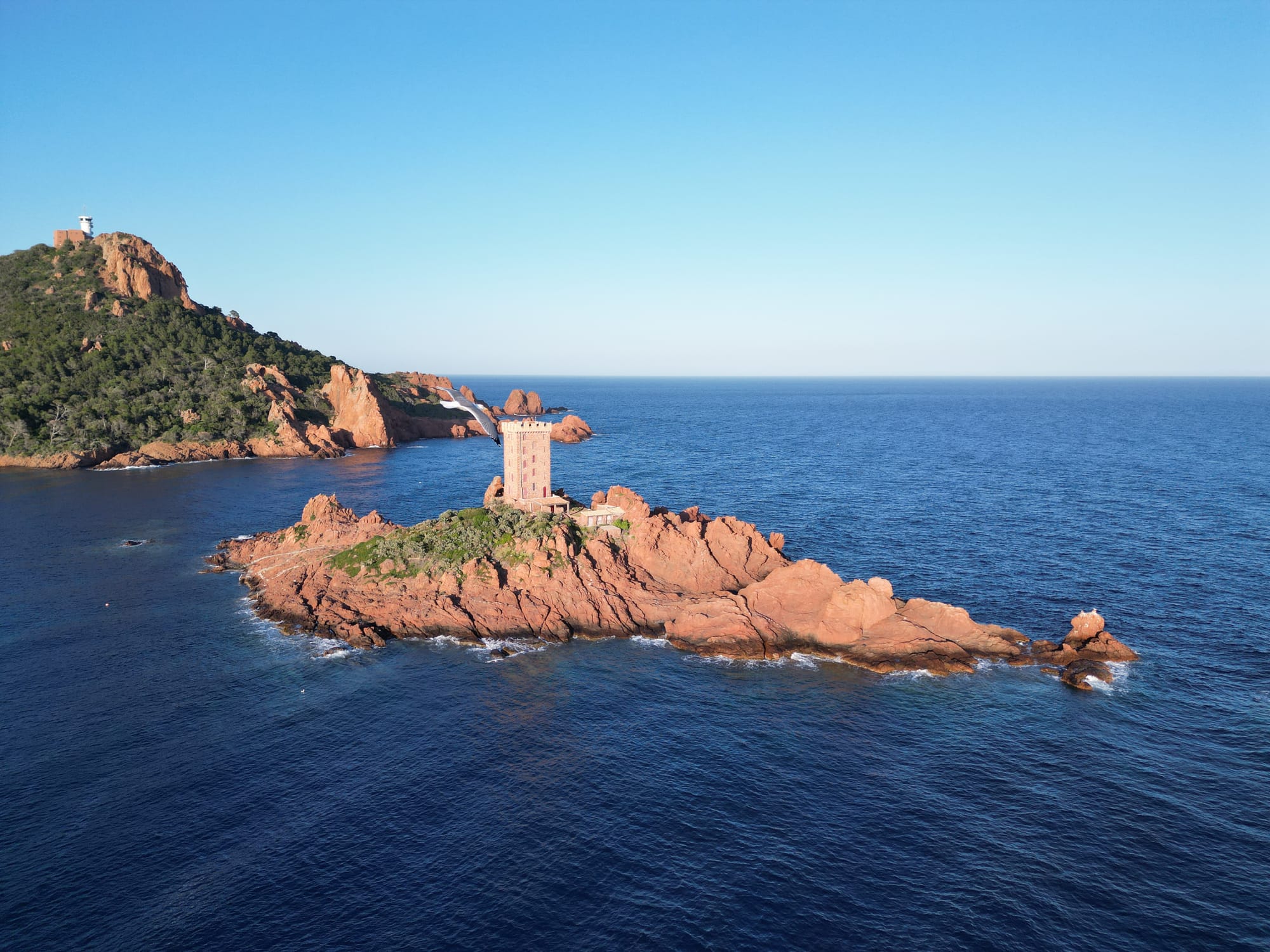
Discover one of the most beautiful corners of the French Riviera, where the dramatic red rocks of the Estérel meet the turquoise Mediterranean, hidden coves invite you to linger and a mysterious little island has its very own king.
Staying at Villa La Cigale or Villa La Cigalette, you can easily enjoy Cap Dramont as a wonderful day trip, with the scenic Corniche d’Or offering a spectacular coastal drive from your Gaia’s Villas holiday home in Théoule-sur-Mer.
The Cap Dramont coastal hiking trail
One of the best ways to discover this extraordinary landscape is on foot. The circular hiking route around Cap Dramont is one of the most rewarding short walks in the Saint-Raphaël area. The official route starts at Plage du Camp Long and follows a combination of coastal paths, rocky tracks and paved sections towards the summit of the cape and its historic semaphore station. Along the way, there are beautiful viewpoints over the Mediterranean, Île d'Or, the Bay of Agay and the surrounding Estérel mountains. The route is approximately 3.8 kilometres long, with around 151 metres of positive elevation gain. It takes roughly two hours at a comfortable walking pace, although you should allow longer if you enjoy stopping for photographs, admiring the scenery or simply sitting down to enjoy the views. The trail is generally classified as easy, but this does not mean that it is completely flat or suitable for every type of footwear. Some sections are rocky, narrow and uneven, and there are a few uphill stretches. Proper walking shoes or sturdy trainers with good grip are recommended.
Starting at Plage du Camp Long
The walk begins at Plage du Camp Long, also known as Tiki Plage, a sheltered sandy beach framed by red rocks and Mediterranean vegetation. From here, follow the yellow-marked coastal path as it winds along the rocky shoreline, past fragrant scrub, dramatic rock formations and crystal-clear coves. The trail gradually climbs towards the higher part of the headland, offering increasingly beautiful views of the sea and Île d’Or, whose tower looks like a little castle floating on the Mediterranean. Take your time – this is a walk best enjoyed slowly.
Along the cliff tops
At the higher section, take the left-hand fork and follow the cliff-top path. This is one of the most spectacular stretches of the walk, with sweeping views across the Mediterranean and along the rugged Estérel coastline. Île d’Or is particularly striking from here, its reddish tower rising above the rocky island like a miniature medieval fortress. The trail eventually reaches a junction; turn right and follow the uphill path towards the paved track and semaphore station.
The semaphore and the panoramic viewpoint
At the summit stands the historic Semaphore du Dramont, a maritime observation station dating back to 1860, built on the site of an earlier watchtower from 1562. Still in active use today, it is closed to visitors, but can be admired from the outside. The climb is rewarded with magnificent panoramic views over the Bay of Agay, the red Estérel mountains, the Mediterranean and Île d’Or. Take a moment to enjoy them – this is certainly not a place to rush past.
A detour to Port du Poussaï
On the return, the route follows a paved track along the southern slopes of Cap Dramont. Before completing the circular walk, take a short detour to Port du Poussaï, a charming little harbour nestled beneath the red cliffs. With its colourful boats and intimate Mediterranean atmosphere, it is a lovely place to pause and admire another view of Île d’Or. Afterwards, retrace your steps and follow the marked path back to Camp Long, completing a walk that captures the very best of the Estérel coastline.
Île d'Or – The tiny island with its very own king
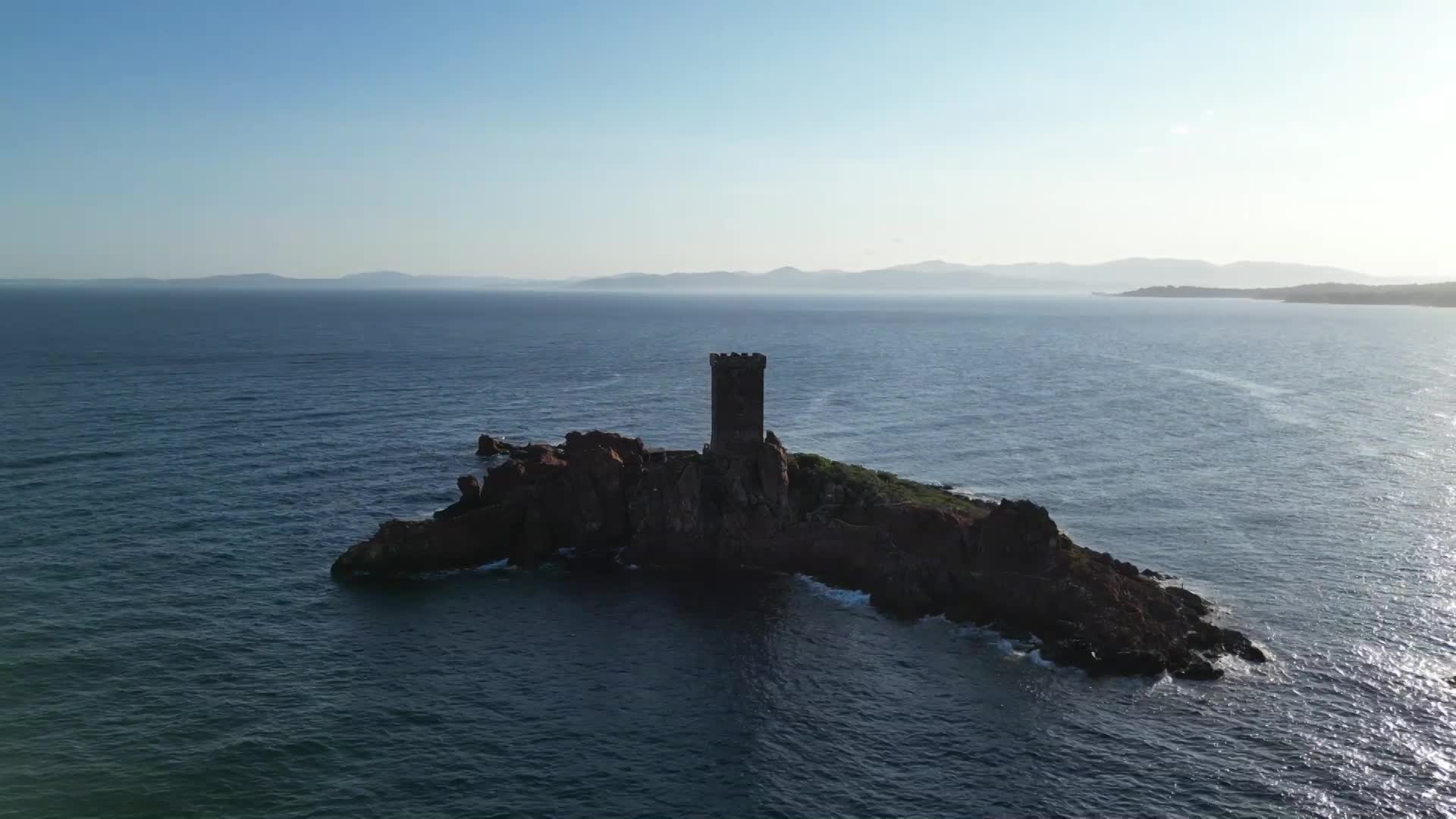
Of all the sights along this coastline, Île d'Or is perhaps the most intriguing. Situated approximately 200 metres offshore from Cap Dramont, this small rocky island is crowned by a magnificent square tower built from the same reddish stone as the surrounding landscape. It looks like something straight out of a medieval adventure story. Yet its history is surprisingly recent, and the story of how the island acquired its tower is one of the most entertaining tales of the French Riviera.
From an ordinary rock to a private island
For much of its history, Île d'Or was little more than a rocky outcrop in the Mediterranean. Everything changed on 11 October 1897, when the island was sold at public auction. The successful bidder was Joseph Léon Sergent, who acquired it for just 280 French francs. To put that into perspective, the island cost roughly the equivalent of a modest bicycle at the time. Not a bad investment for what would eventually become one of the most photographed landmarks on the coast! A few years later, the island passed into the hands of a rather extraordinary character: Dr Auguste Lutaud. According to the account preserved by the descendants of the island's former owners, the transfer was connected to a card game. Léon Sergent had apparently lost a considerable sum of money to Lutaud and offered to settle his debt by giving him the island. Whether the story is entirely accurate or has acquired a little embellishment over the years, it certainly makes for a much more entertaining property transaction than the usual notarial paperwork! The sale was formalised by a notarial deed on 26 January 1909, for 300 gold francs.
The construction of the famous tower
Dr Auguste Lutaud had grand ambitions for his little island. He commissioned a square tower inspired by Saracen architecture, giving Île d’Or the appearance of a miniature Mediterranean fortress. Built from reddish stone quarried directly on the island, the 18-metre tower took sixteen months to complete, in September 1910. Its five floors and remarkably solid construction are impressive enough today, especially considering the challenges of building on such an isolated rocky outcrop. But the tower was only part of Lutaud’s vision.
Welcome to the Kingdom of Île d'Or!
On 19 September 1910, the tower was inaugurated in a celebration worthy of the Belle Époque. Dr Lutaud proclaimed himself Auguste I, King of Île d’Or, complete with a coat of arms and royal motto: Le salut est dans la sincérité – Salvation lies in sincerity. The ceremony attracted an extraordinary guest list, including the prefect of the Var, Louis Hudelo, medal engraver Oscar Roty and Antoine Lumière, father of the famous cinema pioneers. Local schoolchildren also attended, with one pupil chosen to deliver a tribute to the new king. Lutaud went on to host elegant receptions on the island, welcoming artists, writers and fashionable society. One can imagine the scene: boats arriving from the mainland, guests stepping ashore and the Mediterranean sparkling around this rather unusual little kingdom. Auguste I died in 1925. In accordance with his wishes, an urn containing his ashes was placed inside a rock on the island, commemorated by a plaque bearing the year of his death. Not a bad legacy for a man who decided to become king of his own island!
War, restoration and the island's later owners
The Second World War brought a darker chapter to Île d’Or. During the German occupation, the tower was looted and Lutaud’s royal coat of arms was used for target practice by an occupying battery, leaving little of it intact. In 1962, Lutaud’s son sold the island to François Bureau, a former French naval officer, who undertook an extensive restoration. He repaired the tower, rebuilt its floors, installed water cisterns and created a Mediterranean garden, gradually bringing the island back to life. Bureau's attachment to the island was profound. On 16 August 1994, aged 76, he died while swimming around it, the day after attending the 50th-anniversary commemorations of the Provence landings. His children later placed a pink granite memorial plaque on a rock facing the open sea. Further restoration work followed between 1998 and 2018, including the installation of solar panels. Today, Île d’Or remains privately owned by the family and closed to the public, preserving its unusual place in Riviera history.
Did Île d'Or inspire Tintin?
Île d’Or also has a curious connection to the world of Tintin. Fans of Belgian cartoonist Hergé often associate the island with The Black Island (L’Île Noire), one of Tintin’s famous adventures. The story features a mysterious island dominated by an imposing building and inhabited by a rather sinister gorilla named Ranko. Intriguingly, a nearby rock formation off Île d’Or is said to resemble a gorilla’s profile. Did Hergé draw inspiration from the island? It is a popular local theory, although no definitive proof exists. Still, with its unusual tower and mysterious silhouette, Île d’Or certainly looks like the setting for a Tintin adventure!
Cap Dramont and the D-Day landings in Provence
While Île d’Or has a rather romantic history, the nearby coastline witnessed a major military operation during the Second World War. On 15 August 1944, Allied forces launched Operation Dragoon, the invasion of southern France, to liberate Provence and open a second front in France alongside the Normandy campaign. One of the landing sites was Le Dramont, now known as Plage du Débarquement, where American troops of the 36th Infantry Division came ashore. Today, the beach is a peaceful spot of clear water and Mediterranean sunshine, but memorials commemorate the events of August 1944. The contrast between its tranquil setting and the dramatic history it witnessed is a powerful reminder of the past.
Plage du Camp Long – Tiki Plage
This is the starting point for the Cap Dramont circular walk and one of the most attractive beaches in the immediate area. Sheltered by the surrounding rocks and vegetation, it has a lovely natural setting and beautiful clear water. Its sandy shore makes it a particularly pleasant place to relax after the walk. The beach is popular during the summer months, so arriving earlier in the day is a good idea if you want to enjoy a quieter atmosphere.
Plage du Débarquement
A little further along the coastline lies Plage du Débarquement, a large beach with a fascinating history. It is one of the main landing sites of Operation Dragoon and offers beautiful views towards Île d'Or. The beach is a wonderful place to combine a little history with a refreshing swim. It is also particularly attractive for photography, especially when the island is silhouetted against the blue Mediterranean.
When is the best time to visit?
Cap Dramont is beautiful year-round, but spring and autumn are ideal for walking, with pleasant temperatures, fewer visitors and beautiful light.
June is perfect for combining coastal walks with swimming, while
July and August bring warmer seas but also crowds and intense heat. Start early or walk late in the afternoon.
Winter offers peaceful trails and clear views on sunny days, although weather conditions can be less predictable.During periods of high wildfire risk, access to the Estérel and some walking trails may be restricted. Always check official access information before visiting, particularly in summer.
Practical information
- Location: Cap Dramont, Saint-Raphaël, Var, French Riviera.
- Starting point: Plage du Camp Long (Tiki Plage).
- Distance & duration: Approximately 3.8 km; allow around 2 hours.
- Difficulty: Easy to moderate, with some rocky and steep sections.
- Elevation gain: Approximately 151 m.
- Trail markings: Yellow waymarks.
- By car: From Théoule, follow the Corniche d’Or towards Agay and Saint-Raphaël, then follow signs for Tiki Plage. Parking is available near Camp Long but fills quickly in summer.
- By public transport: TER trains stop at Le Dramont. Local bus services are also available; check seasonal timetables.
- Best time: Spring, June and September–October. In July and August, walk early or late in the day.
- What to bring: Walking shoes, water, sun protection and a camera. Bring swimwear and a towel if you plan to visit the beaches.
- Swimming: Possible at nearby beaches and suitable coves, depending on sea conditions.
- Île d’Or: Privately owned and closed to visitors. Admire it from the coast or from an authorised boat excursion; landing is not permitted.
- Semaphore: Historic maritime observation station, dating from 1860; not open to the public.
- Nearby history: Plage du Débarquement commemorates the Allied landings of 15 August 1944.
- Cost: The walking trail is free; parking, transport and boat excursions may incur charges.
- Fire restrictions: Access to the Estérel may be restricted during periods of high wildfire risk. Check official Var forest-access information before setting off. Weather and temporary closures may also affect the route.