A day in Cannes
Cannes: More Than the Red Carpet – A Journey Through History
When most people hear the word Cannes, they immediately think of the red carpet.
Every year, the world's film stars, directors and celebrities descend on the French Riviera for the famous Cannes Film Festival, bringing with them flashbulbs, evening gowns, spectacular jewellery and more than a little glamour.
But Cannes is much more than its film festival.
Behind the luxury hotels, designer boutiques and yachts lies a much older town, with a history stretching back more than two thousand years. Its historic quarter, lively markets, old harbour and winding streets reveal a very different side of Cannes — one that is well worth discovering.
And the best way to do it?
On foot.
From Ligurian Settlement to Riviera Icon
The story of Cannes begins long before the film cameras arrived.
The origins of the town go back to the 2nd century BC, when the Ligurians established a settlement known as Aegitna. The Romans later occupied the area, and the settlement gradually developed around the hill now known as Le Suquet.
The name Cannes evolved over the centuries. In the 10th century, the town was known as Canua, a name associated with the reeds that grew in the area.
It is difficult to imagine this ancient landscape when standing today on La Croisette, surrounded by luxury boutiques and five-star hotels.
But climb up into Le Suquet and the modern city suddenly seems very far away.
Le Suquet: The Old Heart of Cannes
Le Suquet is the oldest part of Cannes and the perfect place to begin exploring the city.
Built on the hill overlooking the Old Port, the neighbourhood is made up of narrow, winding streets, colourful façades, small squares and stairways leading gradually towards the top.
This is Cannes at its most charming.
The atmosphere is wonderfully different from the grand boulevards below. Instead of luxury fashion houses and enormous hotels, you find little restaurants, cafés and local shops tucked into the old streets.
Take your time here. There is no need to follow a strict route.
Wander.
Look up.
Turn down a little side street because it looks interesting.
Some of the best corners of Le Suquet are the ones you discover almost by accident.
Climb to the Top of the Hill
At the summit of Le Suquet stands the Église Notre-Dame d’Espérance, built between the 16th and 17th centuries, together with the remains of the medieval fortifications.
The hill has been the strategic heart of Cannes for centuries.
One of the most recognisable remnants of its medieval past is the square tower of the Castre Museum, which dates back to the 11th century.
From the top, the reward is spectacular.
Look down over the rooftops of the old town towards the Vieux Port, then across the Mediterranean to the Lérins Islands. On a clear day, the view stretches along the coastline and towards the dramatic Esterel mountains.
It is one of the best panoramic viewpoints in Cannes — and a very good reminder that this city was here long before the red carpet.
Marché Forville: The Flavours of Cannes
After exploring Le Suquet, make your way down to Marché Forville, Cannes' famous covered market.
This is where the city feels particularly alive.
The stalls are filled with colourful fruit and vegetables, flowers, herbs, cheeses, olives and local specialities. Depending on the season, you will also find an impressive selection of fresh fish and seafood.
Forville is not simply somewhere to admire the colours and take photographs. It is part of everyday life in Cannes.
Come in the morning, when the market is at its liveliest, and allow yourself time to wander between the stalls.
And if you are staying in a villa or apartment, it is almost impossible to resist buying something for lunch.
A few tomatoes.
Some local cheese.
Fresh fruit.
Perhaps a bottle of rosé.
Suddenly you've got yourself a very good Riviera lunch.
From the Market to the Old Port
From Marché Forville, walk down towards the sea and you will arrive at the Vieux Port, the Old Port of Cannes.
The atmosphere changes once again.
Here, traditional fishing boats share the harbour with sailing yachts and enormous luxury vessels. It is a perfect illustration of Cannes itself: old and new, local and international, traditional and glamorous, all occupying the same waterfront.
Take a moment to look back towards Le Suquet.
From the harbour, the old town rises dramatically above you, crowned by the church and medieval tower.
Then turn towards the Mediterranean.
This is where the famous Riviera feeling begins to take over.
The Palais des Festivals: Enter the World of Cinema
From the Old Port, continue along the waterfront towards the Palais des Festivals et des Congrès.
This is where Cannes' modern international identity comes into full view.
Every year, the Palais becomes the centre of attention during the Cannes Film Festival, when the world's film industry gathers here and the famous red carpet becomes one of the most photographed stretches of carpet in the world.
Even outside festival season, it is worth stopping for a photograph on the famous steps.
And don't forget to look at the pavement around the Palais, where you will find the Chemin des Étoiles — the Cannes version of a Hollywood Walk of Fame, featuring the handprints and signatures of numerous international film stars.
You may not arrive wearing an evening gown.
But nobody says you can't pose like you're about to walk the red carpet.
La Croisette: The Glamorous Side of Cannes
From the Palais, the next part of the walk is perhaps the most famous of all.
La Croisette.
The legendary boulevard follows the curve of Cannes' waterfront for around two kilometres, with the Mediterranean on one side and some of the city's most famous hotels, boutiques and restaurants on the other.
This is the Cannes that most people picture.
The grand hotels.
The designer shops.
The private beaches.
The beautiful yachts offshore.
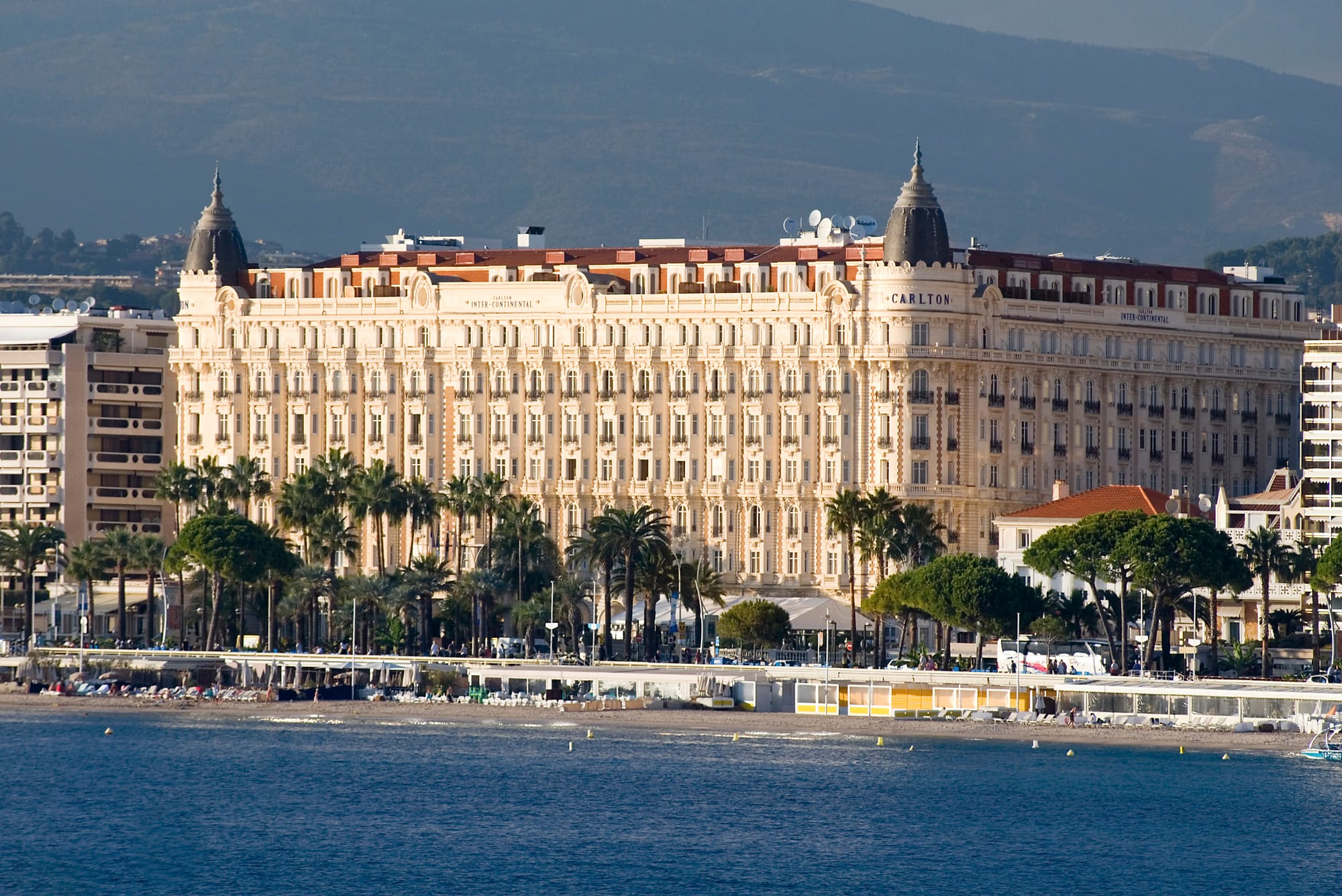
And, of course, the legendary hotels that have hosted generations of film stars and celebrities, including the Carlton Cannes, Hôtel Barrière Le Majestic and JW Marriott Cannes.
But you don't have to spend a fortune to enjoy La Croisette.
The promenade itself is free, and walking along the waterfront is one of the simplest pleasures in Cannes.
Find a bench.
Watch the boats.
Look towards the Lérins Islands.
Or simply enjoy the people-watching.
There is always something going on.
All the Way to Palm Beach
If you have the energy, continue along the Croisette towards Palm Beach, at the eastern end of the bay.
The scenery gradually becomes a little less urban, and the view back towards Cannes is particularly beautiful.
From here, you can appreciate the full sweep of the bay and the city beyond it.
It makes a lovely end to the walk — especially later in the afternoon, when the light begins to soften over the Mediterranean.
If you don't feel like walking the entire distance, you can also use local transport or take the petit train touristique, which offers sightseeing tours around Cannes and is particularly popular with families.
Cannes: Two Cities in One
What makes Cannes so interesting is the contrast.
On one side, you have Le Suquet, with its medieval streets, old church and centuries of history.
Then there is the market, where locals shop for food.
The Old Port brings together fishing boats and superyachts.
The Palais represents the international world of cinema.
And finally, La Croisette delivers all the glamour for which Cannes has become famous.
You can experience all of these sides of the city in a single afternoon.
And that is why I think Cannes is worth visiting even if you couldn't care less about the film festival.
Cannes from Théoule-sur-Mer
For guests staying at Gaia's Villas in Théoule-sur-Mer, Cannes is an especially easy day trip.
The two destinations are close, but the contrast between them could hardly be greater.
In Théoule, you wake up surrounded by the red rocks of the Estérel and the Mediterranean, with a much quieter village atmosphere.
Then, within a short drive, you arrive in Cannes and find yourself surrounded by the energy of the Croisette, luxury boutiques, markets and the international world of the Riviera.
My favourite way to experience Cannes is therefore not to try to see everything.
Start in Le Suquet.
Walk down through the old streets to Marché Forville.
Continue to the Vieux Port and the Palais des Festivals.
Then follow La Croisette along the sea.
Stop for a coffee or an aperitif somewhere along the waterfront.
And eventually, when you've had enough of the glamour, head back to Théoule.
Because one of the great luxuries of staying on this part of the French Riviera is being able to enjoy Cannes whenever you want — and then return to somewhere wonderfully peaceful.
Cannes may be famous for the red carpet, but its real story begins much further back.
And once you've walked from the medieval hill of Le Suquet to the glittering Croisette, you'll have seen both sides of this fascinating Riviera city.